
diff options
Diffstat (limited to 'src/math')
| -rw-r--r-- | src/math/big/calibrate.md | 180 | ||||
| -rw-r--r-- | src/math/big/calibrate_graph.go | 321 | ||||
| -rw-r--r-- | src/math/big/calibrate_test.go | 332 | ||||
| -rw-r--r-- | src/math/big/nat_test.go | 13 | ||||
| -rw-r--r-- | src/math/big/natdiv.go | 2 | ||||
| -rw-r--r-- | src/math/big/natmul.go | 13 |
6 files changed, 724 insertions, 137 deletions
diff --git a/src/math/big/calibrate.md b/src/math/big/calibrate.md new file mode 100644 index 0000000000..ff0b4ea137 --- /dev/null +++ b/src/math/big/calibrate.md @@ -0,0 +1,180 @@ +# Calibration of Algorithm Thresholds + +This document describes the approach to calibration of algorithmic thresholds in +`math/big`, implemented in [calibrate_test.go](calibrate_test.go). + +Basic operations like multiplication and division have many possible implementations. +Most algorithms that are better asymptotically have overheads that make them +run slower for small inputs. When presented with an operation to run, `math/big` +must decide which algorithm to use. + +For example, for small inputs, multiplication using the “grade school algorithm” is fastest. +Given multi-digit x, y and a target z: clear z, and then for each digit y[i], z[i:] += x\*y[i]. +That last operation, adding a vector times a digit to another vector (including carrying up +the vector during the multiplication and addition), can be implemented in a tight assembly loop. +The overall speed is O(N\*\*2) where N is the number of digits in x and y (assume they match), +but the tight inner loop performs well for small inputs. + +[Karatsuba's algorithm](https://en.wikipedia.org/wiki/Karatsuba_algorithm) +multiplies two N-digit numbers by splitting them in half, computing +three N/2-digit products, and then reconstructing the final product using a few more +additions and subtractions. It runs in O(N\*\*log₂ 3) = O(N\*\*1.58) time. +The grade school loop runs faster for small inputs, +but eventually Karatsuba's smaller asymptotic run time wins. + +The multiplication implementation must decide which to use. +Under the assumption that once Karatsuba is faster for some N, +it will be larger for all larger N as well, +the rule is to use Karatsuba's algorithm when the input length N ≥ karatsubaThreshold. + +Calibration is the process of determining what karatsubaThreshold should be set to. +It doesn't sound like it should be that hard, but it is: +- Theoretical analysis does not help: the answer depends on the actual machines +and the actual constant factors in the two implementations. +- We are picking a single karatsubaThreshold for all systems, +despite them having different relative execution speeds for the operations +in the two algorithms. +(We could in theory pick different thresholds for different architectures, +but there can still be significant variation within a given architecture.) +- The assumption that there is a single N where +an asymptotically better algorithm becomes faster and stays faster +is not true in general. +- Recursive algorithms like Karatsuba's may have different optimal +thresholds for different large input sizes. +- Thresholds can interfere. For example, changing the karatsubaThreshold makes +multiplication faster or slower, which in turn affects the best divRecursiveThreshold +(because divisions use multiplication). + +The best we can do is measure the performance of the overall multiplication +algorithm across a variety of inputs and thresholds and look for a threshold +that balances all these concerns reasonably well, +setting thresholds in dependency order (for example, multiplication before division). + +The code in `calibrate_test.go` does this measurement of a variety of input sizes +and threshold values and prints the timing results as a CSV file. +The code in `calibrate_graph.go` reads the CSV and writes out an SVG file plotting the data. +For example: + + go test -run=Calibrate/KaratsubaMul -timeout=1h -calibrate >kmul.csv + go run calibrate_graph.go kmul.csv >kmul.svg + +Any particular input is sensitive to only a few transitions in threshold. +For example, an input of size 320 recurses on inputs of size 160, +which recurses on inputs of size 80, +which recurses on inputs of size 40, +and so on, until falling below the Karatsuba threshold. +Here is what the timing looks like for an input of size 320, +normalized so that 1.0 is the fastest timing observed: + +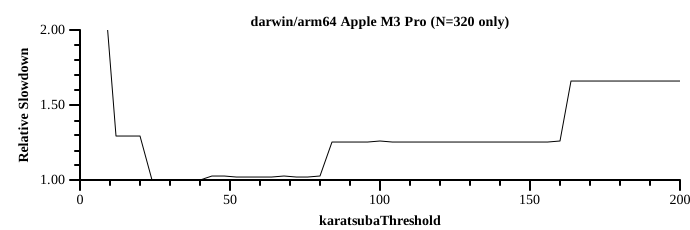 + +For this input, all thresholds from 21 to 40 perform optimally and identically: they all mean “recurse at N=40 but not at N=20”. +From the single input of size N=320, we cannot decide which of these 20 thresholds is best. + +Other inputs exercise other decision points. For example, here is the timing for N=240: + +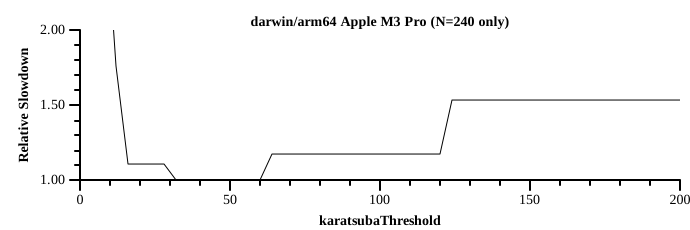 + +In this case, all the thresholds from 31 to 60 perform optimally and identically, recursing at N=60 but not N=30. + +If we combine these two into a single graph and then plot the geometric mean of the two lines in blue, +the optimal range becomes a little clearer: + +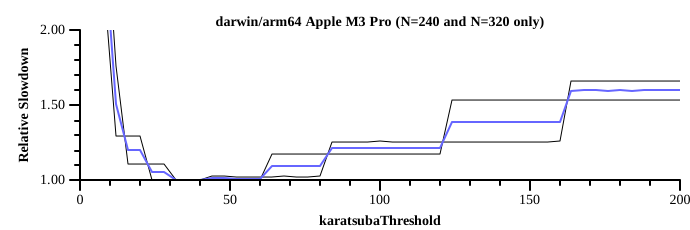 + +The actual calibration runs all possible inputs from size N=200 to N=400, in increments of 8, +plotting all 26 lines in a faded gray (note the changed y-axis scale, zooming in near 1.0). + +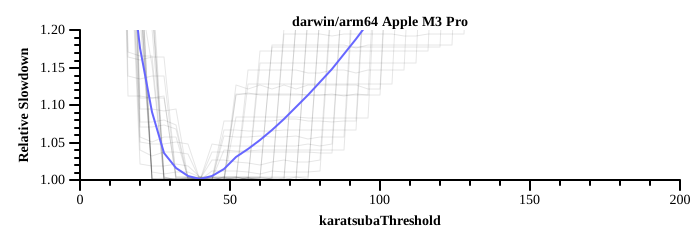 + +Now the optimal value is clear: the best threshold on this chip, with these algorithmic implementations, is 40. + +Unfortunately, other chips are different. Here is an Intel Xeon server chip: + +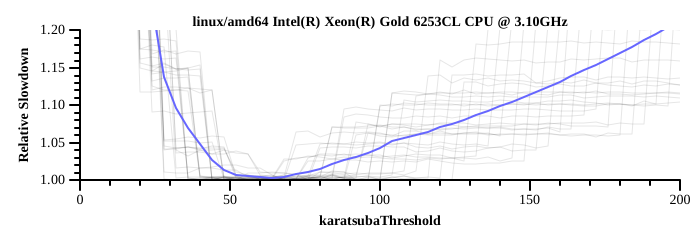 + +On this chip, the best threshold is closer to 60. Luckily, 40 is not a terrible choice either: it is only about 2% slower on average. + +The rest of this document presents the timings measured for the `math/big` thresholds on a variety of machines +and justifies the final thresholds. The timings used these machines: + +- The `gotip-linux-amd64_c3h88-perf_vs_release` gomote, a Google Cloud c3-high-88 machine using an Intel Xeon Platinum 8481C CPU (Emerald Rapids). +- The `gotip-linux-amd64_c2s16-perf_vs_release` gomote, a Google Cloud c2-standard-16 machine using an Intel Xeon Gold 6253CL CPU (Cascade Lake). +- A home server built with an AMD Ryzen 9 7950X CPU. +- The `gotip-linux-arm64_c4as16-perf_vs_release` gomote, a Google Cloud c4a-standard-16 machine using Google's Axiom Arm CPU. +- An Apple MacBook Pro with an Apple M3 Pro CPU. + +In general, we break ties in favor of the newer c3h88 x86 perf gomote, then the c4as16 arm64 perf gomote, and then the others. + +## Karatsuba Multiplication + +Here are the full results for the Karatsuba multiplication threshold. + +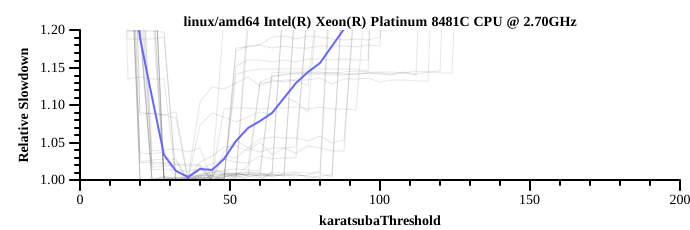 + +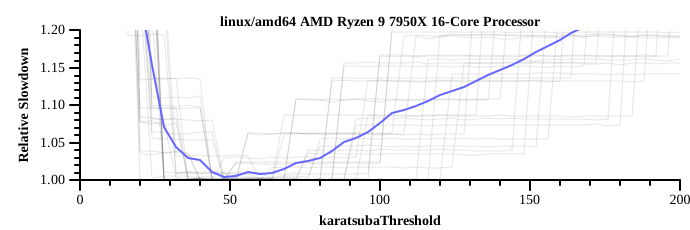 +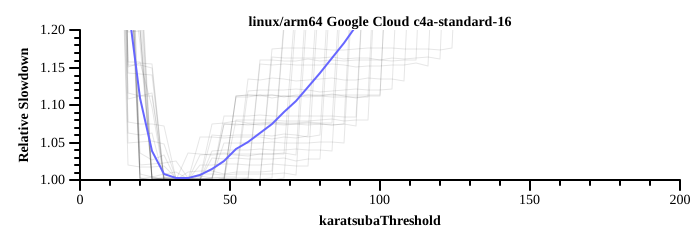 + + +The majority of systems have optimum thresholds near 40, so we chose karatsubaThreshold = 40. + +## Basic Squaring + +For squaring a number (`z.Mul(x, x)`), math/big uses grade school multiplication +up to basicSqrThreshold, where it switches to a customized algorithm that is +still quadratic but avoids half the word-by-word multiplies +since the two arguments are identical. +That algorithm's inner loops are not as tight as the grade school multiplication, +so it is slower for small inputs. How small? + +Here are the timings: + +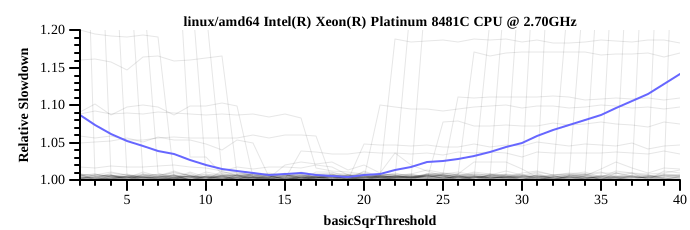 +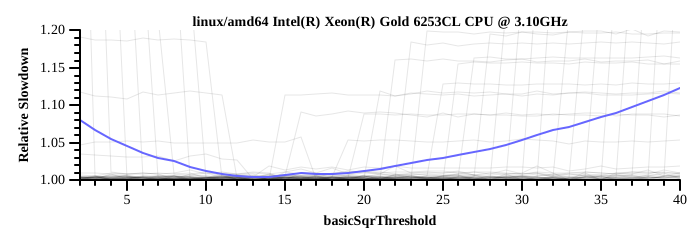 +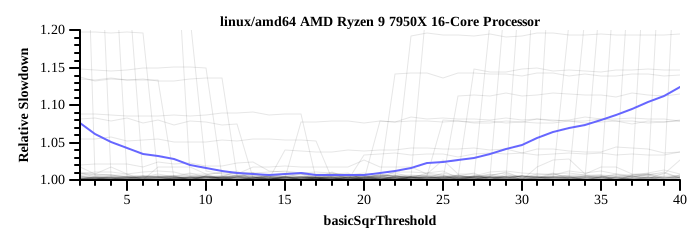 +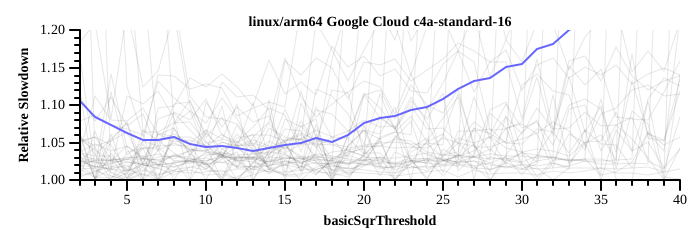 +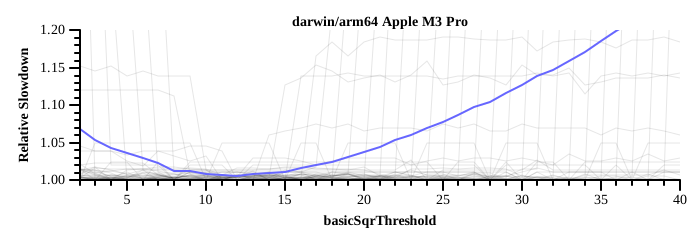 + +These inputs are so small that the calibration times batches of 100 instead of individual operations. +There is no one best threshold, even on a single system, because some of the sizes seem to run +the grade school algorithm faster than others. +For example, on the AMD CPU, +for N=14, basic squaring is 4% faster than basic multiplication, +suggesting the threshold has been crossed, +but for N=16, basic multiplication is 9% faster than basic squaring, +probably because the tight assembly can use larger chunks. + +It is unclear why the Axiom Arm timings are so incredibly noisy. + +We chose basicSqrThreshold = 12. + +## Karatsuba Squaring + +Beyond the basic squaring threshold, at some point a customized Karatsuba can take over. +It uses three half-sized squarings instead of three half-sized multiplies. +Here are the timings: + +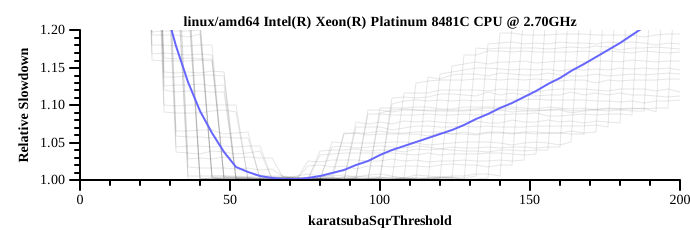 +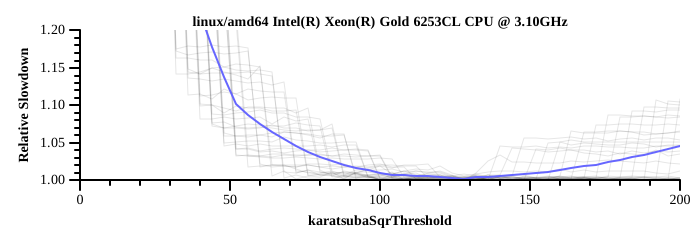 +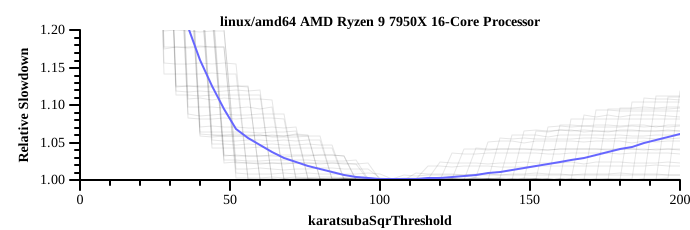 +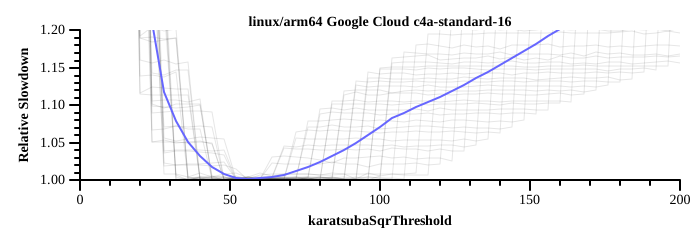 +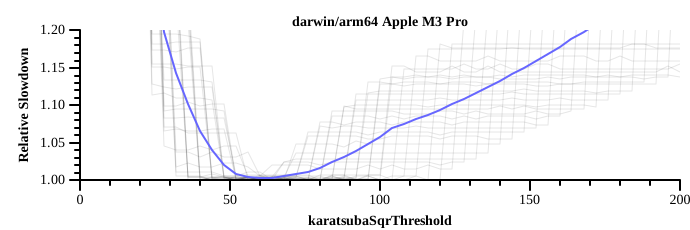 + +The majority of chips preferred a lower threshold, around 60-70, +but the older Intel Xeon and the AMD prefer a threshold around 100-120. + +We chose karatsubaSqrThreshold = 80, which is within 2% of optimal on all the chips. + +## Recursive Division + +Division uses a recursive divide-and-conquer algorithm for large inputs, +eventually falling back to a more traditional grade-school whole-input trial-and-error division. +Here are the timings for the threshold between the two: + +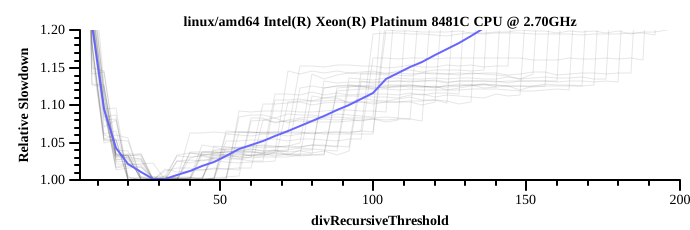 +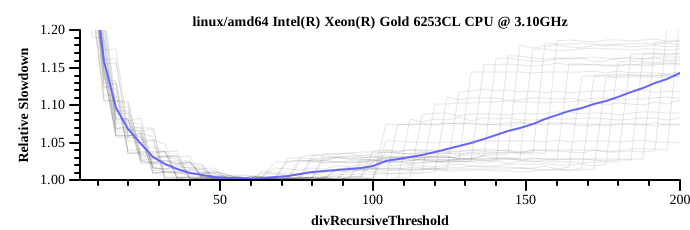 +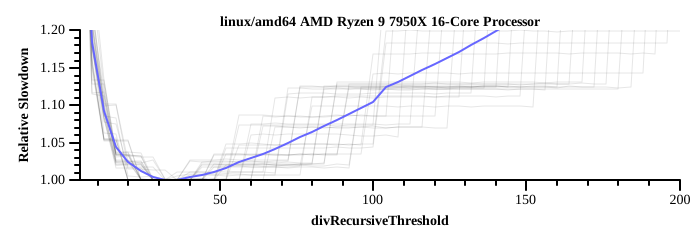 +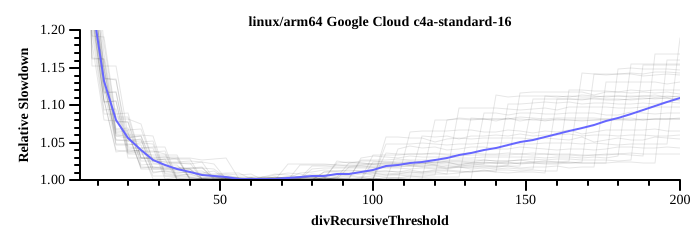 +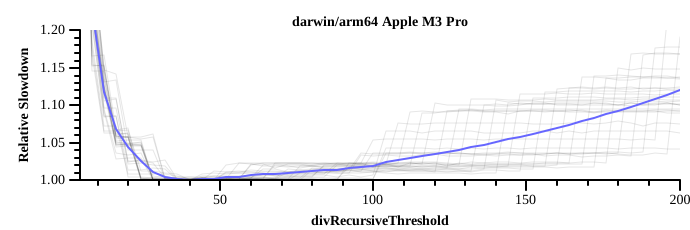 + +We chose divRecursiveThreshold = 40. diff --git a/src/math/big/calibrate_graph.go b/src/math/big/calibrate_graph.go new file mode 100644 index 0000000000..37596195a1 --- /dev/null +++ b/src/math/big/calibrate_graph.go @@ -0,0 +1,321 @@ +// Copyright 2025 The Go Authors. All rights reserved. +// Use of this source code is governed by a BSD-style +// license that can be found in the LICENSE file. + +//go:build ignore + +// This program converts CSV calibration data printed by +// +// go test -run=Calibrate/Name -calibrate >file.csv +// +// into an SVG file. Invoke as: +// +// go run calibrate_graph.go file.csv >file.svg +// +// See calibrate.md for more details. + +package main + +import ( + "bytes" + "encoding/csv" + "flag" + "fmt" + "log" + "math" + "os" + "strconv" +) + +func usage() { + fmt.Fprintf(os.Stderr, "usage: go run calibrate_graph.go file.csv >file.svg\n") + os.Exit(2) +} + +// A Point is an X, Y coordinate in the data being plotted. +type Point struct { + X, Y float64 +} + +// A Graph is a graph to draw as SVG. +type Graph struct { + Title string // title above graph + Geomean []Point // geomean line + Lines [][]Point // normalized data lines + XAxis string // x-axis label + YAxis string // y-axis label + Min Point // min point of data display + Max Point // max point of data display +} + +var yMax = flag.Float64("ymax", 1.2, "maximum y axis value") +var alphaNorm = flag.Float64("alphanorm", 0.1, "alpha for a single norm line") + +func main() { + flag.Usage = usage + flag.Parse() + if flag.NArg() != 1 { + usage() + } + + // Read CSV. It may be enclosed in + // -- name.csv -- + // ... + // -- eof -- + // framing, in which case remove the framing. + fdata, err := os.ReadFile(flag.Arg(0)) + if err != nil { + log.Fatal(err) + } + if _, after, ok := bytes.Cut(fdata, []byte(".csv --\n")); ok { + fdata = after + } + if before, _, ok := bytes.Cut(fdata, []byte("-- eof --\n")); ok { + fdata = before + } + rd := csv.NewReader(bytes.NewReader(fdata)) + rd.FieldsPerRecord = -1 + records, err := rd.ReadAll() + if err != nil { + log.Fatal(err) + } + + // Construct graph from loaded CSV. + // CSV starts with metadata lines like + // goos,darwin + // and then has two tables of timings. + // Each table looks like + // size \ threshold,10,20,30,40 + // 100,1,2,3,4 + // 200,2,3,4,5 + // 300,3,4,5,6 + // 400,4,5,6,7 + // 500,5,6,7,8 + // The header line gives the threshold values and then each row + // gives an input size and the timings for each threshold. + // Omitted timings are empty strings and turn into infinities when parsing. + // The first table gives raw nanosecond timings. + // The second table gives timings normalized relative to the fastest + // possible threshold for a given input size. + // We only want the second table. + // The tables are followed by a list of geomeans of all the normalized + // timings for each threshold: + // geomean,1.2,1.1,1.0,1.4 + // We turn each normalized timing row into a line in the graph, + // and we turn the geomean into an overlaid thick line. + // The metadata is used for preparing the titles. + g := &Graph{ + YAxis: "Relative Slowdown", + Min: Point{0, 1}, + Max: Point{1, 1.2}, + } + meta := make(map[string]string) + table := 0 // number of table headers seen + var thresholds []float64 + maxNorm := 0.0 + for _, rec := range records { + if len(rec) == 0 { + continue + } + if len(rec) == 2 { + meta[rec[0]] = rec[1] + continue + } + if rec[0] == `size \ threshold` { + table++ + if table == 2 { + thresholds = parseFloats(rec) + g.Min.X = thresholds[0] + g.Max.X = thresholds[len(thresholds)-1] + } + continue + } + if rec[0] == "geomean" { + table = 3 // end of norms table + geomeans := parseFloats(rec) + g.Geomean = floatsToLine(thresholds, geomeans) + continue + } + if table == 2 { + if _, err := strconv.Atoi(rec[0]); err != nil { // size + log.Fatalf("invalid table line: %q", rec) + } + norms := parseFloats(rec) + if len(norms) > len(thresholds) { + log.Fatalf("too many timings (%d > %d): %q", len(norms), len(thresholds), rec) + } + g.Lines = append(g.Lines, floatsToLine(thresholds, norms)) + for _, y := range norms { + maxNorm = max(maxNorm, y) + } + continue + } + } + + g.Max.Y = min(*yMax, math.Ceil(maxNorm*100)/100) + g.XAxis = meta["calibrate"] + "Threshold" + g.Title = meta["goos"] + "/" + meta["goarch"] + " " + meta["cpu"] + + os.Stdout.Write(g.SVG()) +} + +// parseFloats parses rec[1:] as floating point values. +// If a field is the empty string, it is represented as +Inf. +func parseFloats(rec []string) []float64 { + floats := make([]float64, 0, len(rec)-1) + for _, v := range rec[1:] { + if v == "" { + floats = append(floats, math.Inf(+1)) + continue + } + f, err := strconv.ParseFloat(v, 64) + if err != nil { + log.Fatalf("invalid record: %q (%v)", rec, err) + } + floats = append(floats, f) + } + return floats +} + +// floatsToLine converts a sequence of floats into a line, ignoring missing (infinite) values. +func floatsToLine(x, y []float64) []Point { + var line []Point + for i, yi := range y { + if !math.IsInf(yi, 0) { + line = append(line, Point{x[i], yi}) + } + } + return line +} + +const svgHeader = `<svg width="%d" height="%d" version="1.1" xmlns="http://www.w3.org/2000/svg"> + <defs> + <style type="text/css"><![CDATA[ + text { stroke-width: 0; white-space: pre; } + text.hjc { text-anchor: middle; } + text.hjl { text-anchor: start; } + text.hjr { text-anchor: end; } + .def { stroke-linecap: round; stroke-linejoin: round; fill: none; stroke: #000000; stroke-width: 1px; } + .tick { stroke: #000000; fill: #000000; font: %dpx Times; } + .title { stroke: #000000; fill: #000000; font: %dpx Times; font-weight: bold; } + .axis { stroke-width: 2px; } + .norm { stroke: rgba(0,0,0,%f); } + .geomean { stroke: #6666ff; stroke-width: 2px; } + ]]></style> + </defs> + <g class="def"> +` + +// Layout constants for drawing graph +const ( + DX = 600 // width of graphed data + DY = 150 // height of graphed data + ML = 80 // margin left + MT = 30 // margin top + MR = 10 // margin right + MB = 50 // margin bottom + PS = 14 // point size of text + W = ML + DX + MR // width of overall graph + H = MT + DY + MB // height of overall graph + Tick = 5 // axis tick length +) + +// An SVGPoint is a point in the SVG image, in pixel units, +// with Y increasing down the page. +type SVGPoint struct { + X, Y int +} + +func (p SVGPoint) String() string { + return fmt.Sprintf("%d,%d", p.X, p.Y) +} + +// pt converts an x, y data value (such as from a Point) to an SVGPoint. +func (g *Graph) pt(x, y float64) SVGPoint { + return SVGPoint{ + X: ML + int((x-g.Min.X)/(g.Max.X-g.Min.X)*DX), + Y: H - MB - int((y-g.Min.Y)/(g.Max.Y-g.Min.Y)*DY), + } +} + +// SVG returns the SVG text for the graph. +func (g *Graph) SVG() []byte { + + var svg bytes.Buffer + fmt.Fprintf(&svg, svgHeader, W, H, PS, PS, *alphaNorm) + + // Draw data, clipped. + fmt.Fprintf(&svg, "<clipPath id=\"cp\"><path d=\"M %v L %v L %v L %v Z\" /></clipPath>\n", + g.pt(g.Min.X, g.Min.Y), g.pt(g.Max.X, g.Min.Y), g.pt(g.Max.X, g.Max.Y), g.pt(g.Min.X, g.Max.Y)) + fmt.Fprintf(&svg, "<g clip-path=\"url(#cp)\">\n") + for _, line := range g.Lines { + if len(line) == 0 { + continue + } + fmt.Fprintf(&svg, "<path class=\"norm\" d=\"M %v", g.pt(line[0].X, line[0].Y)) + for _, v := range line[1:] { + fmt.Fprintf(&svg, " L %v", g.pt(v.X, v.Y)) + } + fmt.Fprintf(&svg, "\"/>\n") + } + // Draw geomean. + if len(g.Geomean) > 0 { + line := g.Geomean + fmt.Fprintf(&svg, "<path class=\"geomean\" d=\"M %v", g.pt(line[0].X, line[0].Y)) + for _, v := range line[1:] { + fmt.Fprintf(&svg, " L %v", g.pt(v.X, v.Y)) + } + fmt.Fprintf(&svg, "\"/>\n") + } + fmt.Fprintf(&svg, "</g>\n") + + // Draw axes and major and minor tick marks. + fmt.Fprintf(&svg, "<path class=\"axis\" d=\"") + fmt.Fprintf(&svg, " M %v L %v", g.pt(g.Min.X, g.Min.Y), g.pt(g.Max.X, g.Min.Y)) // x axis + fmt.Fprintf(&svg, " M %v L %v", g.pt(g.Min.X, g.Min.Y), g.pt(g.Min.X, g.Max.Y)) // y axis + xscale := 10.0 + if g.Max.X-g.Min.X < 100 { + xscale = 1.0 + } + for x := int(math.Ceil(g.Min.X / xscale)); float64(x)*xscale <= g.Max.X; x++ { + if x%5 != 0 { + fmt.Fprintf(&svg, " M %v l 0,%d", g.pt(float64(x)*xscale, g.Min.Y), Tick) + } else { + fmt.Fprintf(&svg, " M %v l 0,%d", g.pt(float64(x)*xscale, g.Min.Y), 2*Tick) + } + } + yscale := 100.0 + if g.Max.Y-g.Min.Y > 0.5 { + yscale = 10 + } + for y := int(math.Ceil(g.Min.Y * yscale)); float64(y) <= g.Max.Y*yscale; y++ { + if y%5 != 0 { + fmt.Fprintf(&svg, " M %v l -%d,0", g.pt(g.Min.X, float64(y)/yscale), Tick) + } else { + fmt.Fprintf(&svg, " M %v l -%d,0", g.pt(g.Min.X, float64(y)/yscale), 2*Tick) + } + } + fmt.Fprintf(&svg, "\"/>\n") + + // Draw tick labels on major marks. + for x := int(math.Ceil(g.Min.X / xscale)); float64(x)*xscale <= g.Max.X; x++ { + if x%5 == 0 { + p := g.pt(float64(x)*xscale, g.Min.Y) + fmt.Fprintf(&svg, "<text x=\"%d\" y=\"%d\" class=\"tick hjc\">%d</text>\n", p.X, p.Y+2*Tick+PS, x*int(xscale)) + } + } + for y := int(math.Ceil(g.Min.Y * yscale)); float64(y) <= g.Max.Y*yscale; y++ { + if y%5 == 0 { + p := g.pt(g.Min.X, float64(y)/yscale) + fmt.Fprintf(&svg, "<text x=\"%d\" y=\"%d\" class=\"tick hjr\">%.2f</text>\n", p.X-2*Tick-Tick, p.Y+PS/3, float64(y)/yscale) + } + } + + // Draw graph title and axis titles. + fmt.Fprintf(&svg, "<text x=\"%d\" y=\"%d\" class=\"title hjc\">%s</text>\n", ML+DX/2, MT-PS/3, g.Title) + fmt.Fprintf(&svg, "<text x=\"%d\" y=\"%d\" class=\"title hjc\">%s</text>\n", ML+DX/2, MT+DY+2*Tick+2*PS+PS/2, g.XAxis) + fmt.Fprintf(&svg, "<g transform=\"translate(%d,%d) rotate(-90)\"><text x=\"0\" y=\"0\" class=\"title hjc\">%s</text></g>\n", ML-Tick-Tick-3*PS, MT+DY/2, g.YAxis) + + fmt.Fprintf(&svg, "</g></svg>\n") + return svg.Bytes() +} diff --git a/src/math/big/calibrate_test.go b/src/math/big/calibrate_test.go index d85833aede..7d44c2ed0f 100644 --- a/src/math/big/calibrate_test.go +++ b/src/math/big/calibrate_test.go @@ -2,172 +2,266 @@ // Use of this source code is governed by a BSD-style // license that can be found in the LICENSE file. -// Calibration used to determine thresholds for using -// different algorithms. Ideally, this would be converted -// to go generate to create thresholds.go - -// This file prints execution times for the Mul benchmark -// given different Karatsuba thresholds. The result may be -// used to manually fine-tune the threshold constant. The -// results are somewhat fragile; use repeated runs to get -// a clear picture. - -// Calculates lower and upper thresholds for when basicSqr -// is faster than standard multiplication. - -// Usage: go test -run='^TestCalibrate$' -v -calibrate +// TestCalibrate determines appropriate thresholds for when to use +// different calculation algorithms. To run it, use: +// +// go test -run=Calibrate -calibrate >cal.log +// +// Calibration data is printed in CSV format, along with the normal test output. +// See calibrate.md for more details about using the output. package big import ( "flag" "fmt" + "internal/sysinfo" + "math" + "runtime" + "slices" + "strings" + "sync" "testing" "time" ) var calibrate = flag.Bool("calibrate", false, "run calibration test") - -const ( - sqrModeMul = "mul(x, x)" - sqrModeBasic = "basicSqr(x)" - sqrModeKaratsuba = "karatsubaSqr(x)" -) +var calibrateOnce sync.Once func TestCalibrate(t *testing.T) { if !*calibrate { return } - computeKaratsubaThresholds() + t.Run("KaratsubaMul", computeKaratsubaThreshold) + t.Run("BasicSqr", computeBasicSqrThreshold) + t.Run("KaratsubaSqr", computeKaratsubaSqrThreshold) + t.Run("DivRecursive", computeDivRecursiveThreshold) +} + +func computeKaratsubaThreshold(t *testing.T) { + set := func(n int) { karatsubaThreshold = n } + computeThreshold(t, "karatsuba", set, 0, 4, 200, benchMul, 200, 8, 400) +} - // compute basicSqrThreshold where overhead becomes negligible - minSqr := computeSqrThreshold(10, 30, 1, 3, sqrModeMul, sqrModeBasic) - // compute karatsubaSqrThreshold where karatsuba is faster - maxSqr := computeSqrThreshold(200, 500, 10, 3, sqrModeBasic, sqrModeKaratsuba) - if minSqr != 0 { - fmt.Printf("found basicSqrThreshold = %d\n", minSqr) - } else { - fmt.Println("no basicSqrThreshold found") +func benchMul(size int) func() { + x := rndNat(size) + y := rndNat(size) + var z nat + return func() { + z.mul(nil, x, y) } - if maxSqr != 0 { - fmt.Printf("found karatsubaSqrThreshold = %d\n", maxSqr) - } else { - fmt.Println("no karatsubaSqrThreshold found") +} + +func computeBasicSqrThreshold(t *testing.T) { + setDuringTest(t, &karatsubaSqrThreshold, 1e9) + set := func(n int) { basicSqrThreshold = n } + computeThreshold(t, "basicSqr", set, 2, 1, 40, benchBasicSqr, 1, 1, 40) +} + +func benchBasicSqr(size int) func() { + x := rndNat(size) + var z nat + return func() { + // Run 100 squarings because 1 is too fast at the small sizes we consider. + // Some systems don't even have precise enough clocks to measure it accurately. + for range 100 { + z.sqr(nil, x) + } } } -func karatsubaLoad(b *testing.B) { - BenchmarkMul(b) +func computeKaratsubaSqrThreshold(t *testing.T) { + set := func(n int) { karatsubaSqrThreshold = n } + computeThreshold(t, "karatsubaSqr", set, 0, 4, 200, benchSqr, 200, 8, 400) } -// measureKaratsuba returns the time to run a Karatsuba-relevant benchmark -// given Karatsuba threshold th. -func measureKaratsuba(th int) time.Duration { - th, karatsubaThreshold = karatsubaThreshold, th - res := testing.Benchmark(karatsubaLoad) - karatsubaThreshold = th - return time.Duration(res.NsPerOp()) +func benchSqr(size int) func() { + x := rndNat(size) + var z nat + return func() { + z.sqr(nil, x) + } } -func computeKaratsubaThresholds() { - fmt.Printf("Multiplication times for varying Karatsuba thresholds\n") - fmt.Printf("(run repeatedly for good results)\n") +func computeDivRecursiveThreshold(t *testing.T) { + set := func(n int) { divRecursiveThreshold = n } + computeThreshold(t, "divRecursive", set, 4, 4, 200, benchDiv, 200, 8, 400) +} - // determine Tk, the work load execution time using basic multiplication - Tb := measureKaratsuba(1e9) // th == 1e9 => Karatsuba multiplication disabled - fmt.Printf("Tb = %10s\n", Tb) +func benchDiv(size int) func() { + divx := rndNat(2 * size) + divy := rndNat(size) + var z, r nat + return func() { + z.div(nil, r, divx, divy) + } +} - // thresholds - th := 4 - th1 := -1 - th2 := -1 +func computeThreshold(t *testing.T, name string, set func(int), thresholdLo, thresholdStep, thresholdHi int, bench func(int) func(), sizeLo, sizeStep, sizeHi int) { + // Start CSV output; wrapped in txtar framing to separate CSV from other test ouptut. + fmt.Printf("-- calibrate-%s.csv --\n", name) + defer fmt.Printf("-- eof --\n") - var deltaOld time.Duration - for count := -1; count != 0 && th < 128; count-- { - // determine Tk, the work load execution time using Karatsuba multiplication - Tk := measureKaratsuba(th) + fmt.Printf("goos,%s\n", runtime.GOOS) + fmt.Printf("goarch,%s\n", runtime.GOARCH) + fmt.Printf("cpu,%s\n", sysinfo.CPUName()) + fmt.Printf("calibrate,%s\n", name) - // improvement over Tb - delta := (Tb - Tk) * 100 / Tb + // Expand lists of sizes and thresholds we will test. + var sizes, thresholds []int + for size := sizeLo; size <= sizeHi; size += sizeStep { + sizes = append(sizes, size) + } + for thresh := thresholdLo; thresh <= thresholdHi; thresh += thresholdStep { + thresholds = append(thresholds, thresh) + } - fmt.Printf("th = %3d Tk = %10s %4d%%", th, Tk, delta) + fmt.Printf("%s\n", csv("size \\ threshold", thresholds)) - // determine break-even point - if Tk < Tb && th1 < 0 { - th1 = th - fmt.Print(" break-even point") + // Track minimum time observed for each size, threshold pair. + times := make([][]float64, len(sizes)) + for i := range sizes { + times[i] = make([]float64, len(thresholds)) + for j := range thresholds { + times[i][j] = math.Inf(+1) } + } - // determine diminishing return - if 0 < delta && delta < deltaOld && th2 < 0 { - th2 = th - fmt.Print(" diminishing return") - } - deltaOld = delta + // For each size, run at most MaxRounds of considering every threshold. + // If we run a threshold Stable times in a row without seeing more + // than a 1% improvement in the observed minimum, move on to the next one. + // After we run Converged rounds (not necessarily in a row) + // without seeing any threshold improve by more than 1%, stop. + const ( + MaxRounds = 1600 + Stable = 20 + Converged = 200 + ) - fmt.Println() + for i, size := range sizes { + b := bench(size) + same := 0 + for range MaxRounds { + better := false + for j, threshold := range thresholds { + // No point if threshold is far beyond size + if false && threshold > size+2*sizeStep { + continue + } - // trigger counter - if th1 >= 0 && th2 >= 0 && count < 0 { - count = 10 // this many extra measurements after we got both thresholds + // BasicSqr is different from the recursive thresholds: it either applies or not, + // without any question of recursive subproblems. Only try the thresholds + // size-1, size, size+1, size+2 + // to get two data points using basic multiplication and two using basic squaring. + // This avoids gathering many redundant data points. + // (The others have redundant data points as well, but for them the math is less trivial + // and best not duplicated in the calibration code.) + if false && name == "basicSqr" && (threshold < size-1 || threshold > size+3) { + continue + } + + set(threshold) + b() // warm up + b() + tmin := times[i][j] + for k := 0; k < Stable; k++ { + start := time.Now() + b() + t := float64(time.Since(start)) + if t < tmin { + if t < tmin*99/100 { + better = true + k = 0 + } + tmin = t + } + } + times[i][j] = tmin + } + if !better { + if same++; same >= Converged { + break + } + } } - th++ + fmt.Printf("%s\n", csv(fmt.Sprint(size), times[i])) } -} -func measureSqr(words, nruns int, mode string) time.Duration { - // more runs for better statistics - initBasicSqr, initKaratsubaSqr := basicSqrThreshold, karatsubaSqrThreshold - - switch mode { - case sqrModeMul: - basicSqrThreshold = words + 1 - case sqrModeBasic: - basicSqrThreshold, karatsubaSqrThreshold = words-1, words+1 - case sqrModeKaratsuba: - karatsubaSqrThreshold = words - 1 + // For each size, normalize timings by the minimum achieved for that size. + fmt.Printf("%s\n", csv("size \\ threshold", thresholds)) + norms := make([][]float64, len(sizes)) + for i, times := range times { + m := min(1e100, slices.Min(times)) // make finite so divide preserves inf values + norms[i] = make([]float64, len(times)) + for j, d := range times { + norms[i][j] = d / m + } + fmt.Printf("%s\n", csv(fmt.Sprint(sizes[i]), norms[i])) } - var testval int64 - for i := 0; i < nruns; i++ { - res := testing.Benchmark(func(b *testing.B) { benchmarkNatSqr(b, words) }) - testval += res.NsPerOp() + // For each threshold, compute geomean of normalized timings across all sizes. + geomeans := make([]float64, len(thresholds)) + for j := range thresholds { + p := 1.0 + n := 0 + for i := range sizes { + if v := norms[i][j]; !math.IsInf(v, +1) { + p *= v + n++ + } + } + if n == 0 { + geomeans[j] = math.Inf(+1) + } else { + geomeans[j] = math.Pow(p, 1/float64(n)) + } } - testval /= int64(nruns) + fmt.Printf("%s\n", csv("geomean", geomeans)) - basicSqrThreshold, karatsubaSqrThreshold = initBasicSqr, initKaratsubaSqr + // Add best threshold and smallest, largest within 10% and 5% of best. + var lo10, lo5, best, hi5, hi10 int + for i, g := range geomeans { + if g < geomeans[best] { + best = i + } + } + lo5 = best + for lo5 > 0 && geomeans[lo5-1] <= 1.05 { + lo5-- + } + lo10 = lo5 + for lo10 > 0 && geomeans[lo10-1] <= 1.10 { + lo10-- + } + hi5 = best + for hi5+1 < len(geomeans) && geomeans[hi5+1] <= 1.05 { + hi5++ + } + hi10 = hi5 + for hi10+1 < len(geomeans) && geomeans[hi10+1] <= 1.10 { + hi10++ + } + fmt.Printf("lo10%%,%d\n", thresholds[lo10]) + fmt.Printf("lo5%%,%d\n", thresholds[lo5]) + fmt.Printf("min,%d\n", thresholds[best]) + fmt.Printf("hi5%%,%d\n", thresholds[hi5]) + fmt.Printf("hi10%%,%d\n", thresholds[hi10]) - return time.Duration(testval) + set(thresholds[best]) } -func computeSqrThreshold(from, to, step, nruns int, lower, upper string) int { - fmt.Printf("Calibrating threshold between %s and %s\n", lower, upper) - fmt.Printf("Looking for a timing difference for x between %d - %d words by %d step\n", from, to, step) - var initPos bool - var threshold int - for i := from; i <= to; i += step { - baseline := measureSqr(i, nruns, lower) - testval := measureSqr(i, nruns, upper) - pos := baseline > testval - delta := baseline - testval - percent := delta * 100 / baseline - fmt.Printf("words = %3d deltaT = %10s (%4d%%) is %s better: %v", i, delta, percent, upper, pos) - if i == from { - initPos = pos - } - if threshold == 0 && pos != initPos { - threshold = i - fmt.Printf(" threshold found") +// csv returns a single csv line starting with name and followed by the values. +// Values that are float64 +infinity, denoting missing data, are replaced by an empty string. +func csv[T int | float64](name string, values []T) string { + line := []string{name} + for _, v := range values { + if math.IsInf(float64(v), +1) { + line = append(line, "") + } else { + line = append(line, fmt.Sprint(v)) } - fmt.Println() - - } - if threshold != 0 { - fmt.Printf("Found threshold = %d between %d - %d\n", threshold, from, to) - } else { - fmt.Printf("Found NO threshold between %d - %d\n", from, to) } - return threshold + return strings.Join(line, ",") } diff --git a/src/math/big/nat_test.go b/src/math/big/nat_test.go index 251877b506..f99fd19293 100644 --- a/src/math/big/nat_test.go +++ b/src/math/big/nat_test.go @@ -378,19 +378,6 @@ func rndNat1(n int) nat { return x } -func BenchmarkMul(b *testing.B) { - stk := getStack() - defer stk.free() - - mulx := rndNat(1e4) - muly := rndNat(1e4) - b.ResetTimer() - for i := 0; i < b.N; i++ { - var z nat - z.mul(stk, mulx, muly) - } -} - func benchmarkNatMul(b *testing.B, nwords int) { x := rndNat(nwords) y := rndNat(nwords) diff --git a/src/math/big/natdiv.go b/src/math/big/natdiv.go index b67d6afeda..1244fb61c5 100644 --- a/src/math/big/natdiv.go +++ b/src/math/big/natdiv.go @@ -722,7 +722,7 @@ func greaterThan(x1, x2, y1, y2 Word) bool { // divRecursiveThreshold is the number of divisor digits // at which point divRecursive is faster than divBasic. -const divRecursiveThreshold = 100 +var divRecursiveThreshold = 40 // see calibrate_test.go // divRecursive implements recursive division as described above. // It overwrites z with ⌊u/v⌋ and overwrites u with the remainder r. diff --git a/src/math/big/natmul.go b/src/math/big/natmul.go index 8ab4d13cba..bd6ab3851c 100644 --- a/src/math/big/natmul.go +++ b/src/math/big/natmul.go @@ -9,7 +9,7 @@ package big // Operands that are shorter than karatsubaThreshold are multiplied using // "grade school" multiplication; for longer operands the Karatsuba algorithm // is used. -var karatsubaThreshold = 40 // computed by calibrate_test.go +var karatsubaThreshold = 40 // see calibrate_test.go // mul sets z = x*y, using stk for temporary storage. // The caller may pass stk == nil to request that mul obtain and release one itself. @@ -65,8 +65,8 @@ func (z nat) mul(stk *stack, x, y nat) nat { // Operands that are shorter than basicSqrThreshold are squared using // "grade school" multiplication; for operands longer than karatsubaSqrThreshold // we use the Karatsuba algorithm optimized for x == y. -var basicSqrThreshold = 20 // computed by calibrate_test.go -var karatsubaSqrThreshold = 260 // computed by calibrate_test.go +var basicSqrThreshold = 12 // see calibrate_test.go +var karatsubaSqrThreshold = 80 // see calibrate_test.go // sqr sets z = x*x, using stk for temporary storage. // The caller may pass stk == nil to request that sqr obtain and release one itself. @@ -87,7 +87,7 @@ func (z nat) sqr(stk *stack, x nat) nat { } z = z.make(2 * n) - if n < basicSqrThreshold { + if n < basicSqrThreshold && n < karatsubaSqrThreshold { basicMul(z, x, x) return z.norm() } @@ -112,6 +112,11 @@ func (z nat) sqr(stk *stack, x nat) nat { // The (non-normalized) result is placed in z. func basicSqr(stk *stack, z, x nat) { n := len(x) + if n < basicSqrThreshold { + basicMul(z, x, x) + return + } + defer stk.restore(stk.save()) t := stk.nat(2 * n) clear(t) |